

Clostridium perfringens JCM 3819 is a mesophilic prokaryote that produces toxins and was isolated from Lamb with "pulpy kidney".
toxin production mesophilic 16S sequence| @ref 20215 |
|
|
| Domain Bacteria |
| Phylum Bacillota |
| Class Clostridia |
| Order Eubacteriales |
| Family Clostridiaceae |
| Genus Clostridium |
| Species Clostridium perfringens |
| Full scientific name Clostridium perfringens (Veillon and Zuber 1898) Hauduroy et al. 1937 (Approved Lists 1980) |
| Synonyms (2) |
| @ref | Growth | Type | Temperature (°C) | Range | |
|---|---|---|---|---|---|
| 67770 | positive | growth | 37 | mesophilic |
| 67770 | Sample typeLamb with "pulpy kidney" |
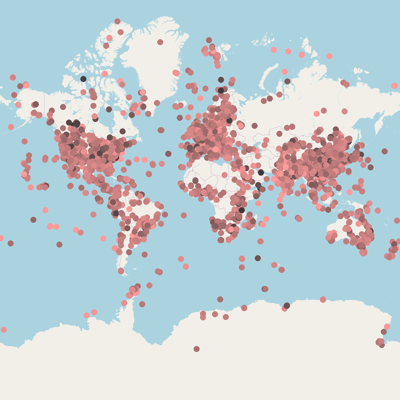
Global distribution of 16S sequence LC037206 (>99% sequence identity) for Clostridium perfringens subclade from Microbeatlas ![]()
| @ref | Description | Accession | Length | Database | NCBI tax ID | |
|---|---|---|---|---|---|---|
| 67770 | Clostridium perfringens gene for 16S ribosomal RNA, partial sequence, strain: JCM 3819 | LC037206 | 1474 | 1502 |
| Topic | Title | Authors | Journal | DOI | Year | |
|---|---|---|---|---|---|---|
| Occurrence of Clostridium perfringens in Wild Mammals in the Amazon Biome. | Oliveira HGDS, Sousa AIJ, Zanon IP, Lopes CTA, Silva ROS, Domingues SFS, Salvarani FM. | Animals (Basel) | 10.3390/ani14091333 | 2024 | ||
| Detection and toxin typing of Clostridium perfringens in formalin-fixed, paraffin-embedded tissue samples by PCR. | Wu J, Zhang W, Xie B, Wu M, Tong X, Kalpoe J, Zhang D. | J Clin Microbiol | 10.1128/jcm.01324-08 | 2009 | ||
| Enzymology | First case of type E wound botulism diagnosed using real-time PCR. | Artin I, Bjorkman P, Cronqvist J, Radstrom P, Holst E. | J Clin Microbiol | 10.1128/jcm.01192-07 | 2007 | |
| Rabbit ileal loop response to strains of Clostridium perfringens. | Duncan CL, Sugiyama H, Strong DH. | J Bacteriol | 10.1128/jb.95.5.1560-1566.1968 | 1968 | ||
| Phylogeny | Development of a combined selection and enrichment PCR procedure for Clostridium botulinum Types B, E, and F and its use to determine prevalence in fecal samples from slaughtered pigs. | Dahlenborg M, Borch E, Radstrom P. | Appl Environ Microbiol | 10.1128/aem.67.10.4781-4788.2001 | 2001 | |
| Effect of Intramuscular or Intrahepatic Injections of Clostridium perfringens on Rabbit Serum Lactate Dehydrogenase. | Thomason D. | Infect Immun | 10.1128/iai.2.2.123-126.1970 | 1970 | ||
| Metabolism | Polysaccharide from dry navy beans, Phaseolus vulgaris: Iits isolation and stimulation of Clostridium perfringens. | Kurtzman RH, Halbrook WU. | Appl Microbiol | 10.1128/am.20.5.715-719.1970 | 1970 | |
| Phylogeny | Electrophoretic study of Clostridium species. | Cato EP, Hash DE, Holdeman LV, Moore WE. | J Clin Microbiol | 10.1128/jcm.15.4.688-702.1982 | 1982 |
| #20215 | Parte, A.C., Sardà Carbasse, J., Meier-Kolthoff, J.P., Reimer, L.C. and Göker, M.: List of Prokaryotic names with Standing in Nomenclature (LPSN) moves to the DSMZ. IJSEM ( DOI 10.1099/ijsem.0.004332 ) |
| #67770 | Japan Collection of Microorganism (JCM) ; Curators of the JCM; |
| #69479 | João F Matias Rodrigues, Janko Tackmann,Gregor Rot, Thomas SB Schmidt, Lukas Malfertheiner, Mihai Danaila,Marija Dmitrijeva, Daniela Gaio, Nicolas Näpflin and Christian von Mering. University of Zurich.: MicrobeAtlas 1.0 beta . |
| #126262 | A. Lissin, I. Schober, J. F. Witte, H. Lüken, A. Podstawka, J. Koblitz, B. Bunk, P. Dawyndt, P. Vandamme, P. de Vos, J. Overmann, L. C. Reimer: StrainInfo—the central database for linked microbial strain identifiers. ( DOI 10.1093/database/baaf059 ) |
You found an error in BacDive? Please tell us about it!
Note that changes will be reviewed and judged. If your changes are legitimate, changes will occur within the next BacDive update. Only proposed changes supported by the according reference will be reviewed. The BacDive team reserves the right to reject proposed changes.
Successfully sent
If you want to cite this particular strain cite the following doi:
https://doi.org/10.13145/bacdive164825.20251217.10
When using BacDive for research please cite the following paper
BacDive in 2025: the core database for prokaryotic strain data