

Thioalkalivibrio thiocyanodenitrificans DSM 16954 is a bacterium that was isolated from mixed sediment samples from 8 hypersaline, alkaline lakes.
genome sequence 16S sequence Bacteria| @ref 20215 |
|
|
| Domain Bacteria |
| Phylum Pseudomonadota |
| Class Gammaproteobacteria |
| Order Chromatiales |
| Family Ectothiorhodospiraceae |
| Genus Thioalkalivibrio |
| Species Thioalkalivibrio thiocyanodenitrificans |
| Full scientific name Thioalkalivibrio thiocyanodenitrificans corrig. Sorokin et al. 2005 |
| Synonyms (1) |
| @ref | Name | Growth | Medium link | Composition | |
|---|---|---|---|---|---|
| 6666 | THIOALKALIVIBRIO THIOCYANODENITRIFICANS MEDIUM (DSMZ Medium 1228) | Medium recipe at MediaDive | Name: THIOALKALIVIBRIO THIOCYANODENITRIFICANS MEDIUM (DSMZ Medium 1228) Composition: Na2CO3 22.0 g/l Sodium thiosulfate pentahydrate 9.92744 g/l NaHCO3 8.0 g/l NaCl 5.0 g/l K2HPO4 1.0 g/l KSCN 0.9718 g/l H3BO3 0.0006 g/l CoCl2 x 6 H2O 0.0004 g/l ZnSO4 x 7 H2O 0.0002 g/l MnCl2 x 4 H2O 6e-05 g/l Na2MoO4 x 2 H2O 6e-05 g/l NiCl2 x 6 H2O 4e-05 g/l CuCl2 x 2 H2O 2e-05 g/l EDTA 1e-05 g/l FeSO4 x 7 H2O 4e-06 g/l MgCl2 x 6 H2O Distilled water |
| @ref | Growth | Type | Temperature (°C) | |
|---|---|---|---|---|
| 6666 | positive | growth | 28 |
| Cat1 | Cat2 | Cat3 | |
|---|---|---|---|
| #Environmental | #Aquatic | #Lake (large) | |
| #Environmental | #Aquatic | #Sediment | |
| #Condition | #Alkaline | - | |
| #Condition | #Saline | - |
| @ref | Sample type | Geographic location | Country | Country ISO 3 Code | Continent | |
|---|---|---|---|---|---|---|
| 6666 | mixed sediment samples from 8 hypersaline, alkaline lakes | Wadi Natrun | Egypt | EGY | Africa |
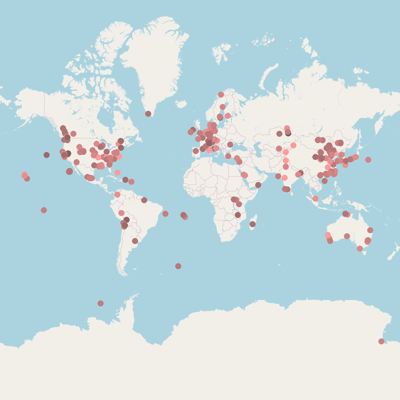
Global distribution of 16S sequence AY360060 (>99% sequence identity) for Thioalkalivibrio from Microbeatlas ![]()
| @ref | Description | Assembly level | INSDC accession | BV-BRC accession | IMG accession | NCBI tax ID | Score | |
|---|---|---|---|---|---|---|---|---|
| 124043 | ASM37896v1 assembly for Thioalkalivibrio thiocyanodenitrificans ARhD 1 | scaffold | 713586 | 70.89 |
| @ref | Description | Accession | Length | Database | NCBI tax ID | |
|---|---|---|---|---|---|---|
| 6666 | Thialkalivibrio thiocyanodenitrificans strain ARhD 16S ribosomal RNA gene, partial sequence | AY360060 | 1442 | 713586 |
| Topic | Title | Authors | Journal | DOI | Year | |
|---|---|---|---|---|---|---|
| Partial genome sequence of Thioalkalivibrio thiocyanodenitrificans ARhD 1(T), a chemolithoautotrophic haloalkaliphilic sulfur-oxidizing bacterium capable of complete denitrification. | Berben T, Sorokin DY, Ivanova N, Pati A, Kyrpides N, Goodwin LA, Woyke T, Muyzer G. | Stand Genomic Sci | 10.1186/s40793-015-0080-3 | 2015 | ||
| Metabolism | Exploring anaerobic environments for cyanide and cyano-derivatives microbial degradation. | Luque-Almagro VM, Cabello P, Saez LP, Olaya-Abril A, Moreno-Vivian C, Roldan MD. | Appl Microbiol Biotechnol | 10.1007/s00253-017-8678-6 | 2018 | |
| Enzymology | Comparative Genome Analysis of Three Thiocyanate Oxidizing Thioalkalivibrio Species Isolated from Soda Lakes. | Berben T, Overmars L, Sorokin DY, Muyzer G. | Front Microbiol | 10.3389/fmicb.2017.00254 | 2017 | |
| Enzymology | Comparative Genomics of Thiohalobacter thiocyanaticus HRh1T and Guyparkeria sp. SCN-R1, Halophilic Chemolithoautotrophic Sulfur-Oxidizing Gammaproteobacteria Capable of Using Thiocyanate as Energy Source. | Tsallagov SI, Sorokin DY, Tikhonova TV, Popov VO, Muyzer G. | Front Microbiol | 10.3389/fmicb.2019.00898 | 2019 | |
| Metabolism | Coregulated genes link sulfide:quinone oxidoreductase and arsenic metabolism in Synechocystis sp. strain PCC6803. | Nagy CI, Vass I, Rakhely G, Vass IZ, Toth A, Duzs A, Peca L, Kruk J, Kos PB. | J Bacteriol | 10.1128/jb.01864-14 | 2014 | |
| Microbiome Dynamics of a Polychlorobiphenyl (PCB) Historically Contaminated Marine Sediment under Conditions Promoting Reductive Dechlorination. | Matturro B, Ubaldi C, Rossetti S. | Front Microbiol | 10.3389/fmicb.2016.01502 | 2016 | ||
| Phylogeny | Broad Phylogenetic Diversity Associated with Nitrogen Loss through Sulfur Oxidation in a Large Public Marine Aquarium. | Burns AS, Padilla CC, Pratte ZA, Gilde K, Regensburger M, Hall E, Dove ADM, Stewart FJ. | Appl Environ Microbiol | 10.1128/aem.01250-18 | 2018 | |
| Pyrosequencing of bacterial symbionts within Axinella corrugata sponges: diversity and seasonal variability. | White JR, Patel J, Ottesen A, Arce G, Blackwelder P, Lopez JV. | PLoS One | 10.1371/journal.pone.0038204 | 2012 | ||
| Dissociation of the NIC plasmid aggregate in Pseudomonas putida. | Thacker R, Gunsalus IC. | J Bacteriol | 10.1128/jb.137.1.697-699.1979 | 1979 | ||
| BimD/SPO76 is at the interface of cell cycle progression, chromosome morphogenesis, and recombination. | van Heemst D, Kafer E, John T, Heyting C, van Aalderen M, Zickler D. | Proc Natl Acad Sci U S A | 10.1073/pnas.081088498 | 2001 | ||
| Phylogeny | Woeseia oceani gen. nov., sp. nov., a chemoheterotrophic member of the order Chromatiales, and proposal of Woeseiaceae fam. nov. | Du ZJ, Wang ZJ, Zhao JX, Chen GJ. | Int J Syst Evol Microbiol | 10.1099/ijsem.0.000683 | 2016 |
| #6666 | Leibniz Institut DSMZ-Deutsche Sammlung von Mikroorganismen und Zellkulturen GmbH ; Curators of the DSMZ; DSM 16954 |
| #20215 | Parte, A.C., Sardà Carbasse, J., Meier-Kolthoff, J.P., Reimer, L.C. and Göker, M.: List of Prokaryotic names with Standing in Nomenclature (LPSN) moves to the DSMZ. IJSEM ( DOI 10.1099/ijsem.0.004332 ) |
| #69479 | João F Matias Rodrigues, Janko Tackmann,Gregor Rot, Thomas SB Schmidt, Lukas Malfertheiner, Mihai Danaila,Marija Dmitrijeva, Daniela Gaio, Nicolas Näpflin and Christian von Mering. University of Zurich.: MicrobeAtlas 1.0 beta . |
| #124043 | Isabel Schober, Julia Koblitz: Data extracted from sequence databases, automatically matched based on designation and taxonomy . |
| #126262 | A. Lissin, I. Schober, J. F. Witte, H. Lüken, A. Podstawka, J. Koblitz, B. Bunk, P. Dawyndt, P. Vandamme, P. de Vos, J. Overmann, L. C. Reimer: StrainInfo—the central database for linked microbial strain identifiers. ( DOI 10.1093/database/baaf059 ) |
You found an error in BacDive? Please tell us about it!
Note that changes will be reviewed and judged. If your changes are legitimate, changes will occur within the next BacDive update. Only proposed changes supported by the according reference will be reviewed. The BacDive team reserves the right to reject proposed changes.
Successfully sent
If you want to cite this particular strain cite the following doi:
https://doi.org/10.13145/bacdive4297.20251217.10
When using BacDive for research please cite the following paper
BacDive in 2025: the core database for prokaryotic strain data