Nitratidesulfovibrio oxamicus DSM 1925 is an anaerobe bacterium that was isolated from mud.
anaerobe genome sequence 16S sequence Bacteria| @ref 20215 |
|
|
| Domain Bacteria |
| Phylum Thermodesulfobacteriota |
| Class Desulfovibrionia |
| Order Desulfovibrionales |
| Family Desulfovibrionaceae |
| Genus Nitratidesulfovibrio |
| Species Nitratidesulfovibrio oxamicus |
| Full scientific name Nitratidesulfovibrio oxamicus (Postgate and Campbell 1966) Waite et al. 2020 |
| Synonyms (3) |
| @ref | Gram stain | Confidence | |
|---|---|---|---|
| 125438 | negative | 95.691 |
| @ref | Name | Growth | Medium link | Composition | |
|---|---|---|---|---|---|
| 669 | DESULFOVIBRIO (POSTGATE) MEDIUM (DSMZ Medium 63) | Medium recipe at MediaDive | Name: DESULFOVIBRIO (POSTGATE) MEDIUM (DSMZ Medium 63) Composition: MgSO4 x 7 H2O 2.0 g/l Na-DL-lactate 2.0 g/l NH4Cl 1.0 g/l Yeast extract 1.0 g/l Na2SO4 1.0 g/l FeSO4 x 7 H2O 0.5 g/l K2HPO4 0.5 g/l CaCl2 x 2 H2O 0.1 g/l Na-thioglycolate 0.1 g/l Ascorbic acid 0.1 g/l Sodium resazurin 0.0005 g/l Distilled water |
| @ref | Growth | Type | Temperature (°C) | |
|---|---|---|---|---|
| 669 | positive | growth | 30 |
| @ref | Sample type | Geographic location | Country | Country ISO 3 Code | Continent | |
|---|---|---|---|---|---|---|
| 669 | mud | Illinois, Monticello near Urbana | USA | USA | North America |
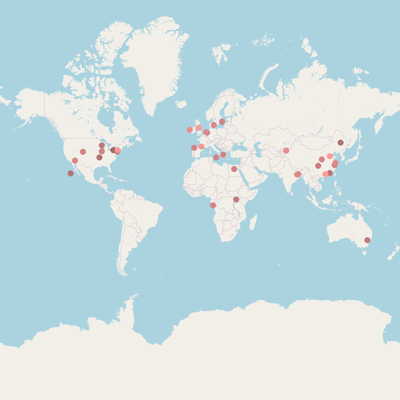
Global distribution of 16S sequence DQ122124 (>99% sequence identity) for Desulfovibrionaceae from Microbeatlas ![]()
| @ref | Description | Assembly level | INSDC accession | BV-BRC accession | IMG accession | NCBI tax ID | Score | |
|---|---|---|---|---|---|---|---|---|
| 66792 | ASM1573176v1 assembly for Nitratidesulfovibrio oxamicus NCIMB 9442 | contig | 32016 | 0 |
| @ref | Trait | Model | Prediction | Confidence in % | In training data |
|---|---|---|---|---|---|
| 125439 | oxygen_tolerance | BacteriaNetⓘ | facultative anaerobe | 92.64 | no |
| 125439 | gram_stain | BacteriaNetⓘ | negative | 76.57 | no |
| 125439 | motility | BacteriaNetⓘ | yes | 58.36 | no |
| 125439 | spore_formation | BacteriaNetⓘ | no | 97.66 | no |
| @ref | Trait | Model | Prediction | Confidence in % | In training data |
|---|---|---|---|---|---|
| 125438 | gram-positive | gram-positiveⓘ | no | 95.69 | no |
| 125438 | anaerobic | anaerobicⓘ | yes | 79.46 | yes |
| 125438 | spore-forming | spore-formingⓘ | no | 86.18 | no |
| 125438 | aerobic | aerobicⓘ | no | 87.23 | yes |
| 125438 | thermophilic | thermophileⓘ | no | 92.84 | yes |
| 125438 | flagellated | motile2+ⓘ | yes | 78.18 | no |
| Topic | Title | Authors | Journal | DOI | Year | |
|---|---|---|---|---|---|---|
| Genetics | Establishment of Genome Based Criteria for Classification of the Family Desulfovibrionaceae and Proposal of Two Novel Genera, Alkalidesulfovibrio gen. nov. and Salidesulfovibrio gen. nov. | Park MJ, Kim YJ, Park M, Yu J, Namirimu T, Roh YR, Kwon KK. | Front Microbiol | 10.3389/fmicb.2022.738205 | 2022 | |
| Metabolism | Microbial ecology of arsenic-mobilizing Cambodian sediments: lithological controls uncovered by stable-isotope probing. | Hery M, Rizoulis A, Sanguin H, Cooke DA, Pancost RD, Polya DA, Lloyd JR | Environ Microbiol | 10.1111/1462-2920.12412 | 2014 | |
| Phylogeny | Cupidesulfovibrio liaohensis gen. nov., sp. nov., a novel sulphate-reducing bacterium isolated from an oil reservoir and reclassification of Desulfovibrio oxamicus and Desulfovibrio termitidis as Cupidesulfovibrio oxamicus comb. nov. and Cupidesulfovibrio termitidis comb. nov. | Wan YY, Luo N, Liu XL, Lai QL, Goodfellow M | Int J Syst Evol Microbiol | 10.1099/ijsem.0.004618 | 2021 | |
| Phylogeny | Reclassification of the sulfate- and nitrate-reducing bacterium Desulfovibrio vulgaris subsp. oxamicus as Desulfovibrio oxamicus sp. nov., comb. nov. | Lopez-Cortes A, Fardeau ML, Fauque G, Joulian C, Ollivier B | Int J Syst Evol Microbiol | 10.1099/ijs.0.64074-0 | 2006 |
| #669 | Leibniz Institut DSMZ-Deutsche Sammlung von Mikroorganismen und Zellkulturen GmbH ; Curators of the DSMZ; DSM 1925 |
| #20215 | Parte, A.C., Sardà Carbasse, J., Meier-Kolthoff, J.P., Reimer, L.C. and Göker, M.: List of Prokaryotic names with Standing in Nomenclature (LPSN) moves to the DSMZ. IJSEM ( DOI 10.1099/ijsem.0.004332 ) |
| #20218 | Verslyppe, B., De Smet, W., De Baets, B., De Vos, P., Dawyndt P.: StrainInfo introduces electronic passports for microorganisms.. Syst Appl Microbiol. 37: 42 - 50 2014 ( DOI 10.1016/j.syapm.2013.11.002 , PubMed 24321274 ) |
| #66792 | Julia Koblitz, Joaquim Sardà, Lorenz Christian Reimer, Boyke Bunk, Jörg Overmann: Automatically annotated for the DiASPora project (Digital Approaches for the Synthesis of Poorly Accessible Biodiversity Information) . |
| #69479 | João F Matias Rodrigues, Janko Tackmann,Gregor Rot, Thomas SB Schmidt, Lukas Malfertheiner, Mihai Danaila,Marija Dmitrijeva, Daniela Gaio, Nicolas Näpflin and Christian von Mering. University of Zurich.: MicrobeAtlas 1.0 beta . |
| #125438 | Julia Koblitz, Lorenz Christian Reimer, Rüdiger Pukall, Jörg Overmann: Predicting bacterial phenotypic traits through improved machine learning using high-quality, curated datasets. 2024 ( DOI 10.1101/2024.08.12.607695 ) |
| #125439 | Philipp Münch, René Mreches, Martin Binder, Hüseyin Anil Gündüz, Xiao-Yin To, Alice McHardy: deepG: Deep Learning for Genome Sequence Data. R package version 0.3.1 . |
| #126262 | A. Lissin, I. Schober, J. F. Witte, H. Lüken, A. Podstawka, J. Koblitz, B. Bunk, P. Dawyndt, P. Vandamme, P. de Vos, J. Overmann, L. C. Reimer: StrainInfo—the central database for linked microbial strain identifiers. ( DOI 10.1093/database/baaf059 ) |
You found an error in BacDive? Please tell us about it!
Note that changes will be reviewed and judged. If your changes are legitimate, changes will occur within the next BacDive update. Only proposed changes supported by the according reference will be reviewed. The BacDive team reserves the right to reject proposed changes.
Successfully sent
If you want to cite this particular strain cite the following doi:
https://doi.org/10.13145/bacdive4104.20260601.11
When using BacDive for research please cite the following paper
BacDive in 2025: the core database for prokaryotic strain data