Orbus hercynius DSM 22228 is a facultative anaerobe, mesophilic, ovoid-shaped prokaryote that was isolated from faeces of wild boar.
ovoid-shaped facultative anaerobe mesophilic genome sequence 16S sequence| @ref 20215 |
|
|
| Domain Pseudomonadati |
| Phylum Pseudomonadota |
| Class Gammaproteobacteria |
| Order Orbales |
| Family Orbaceae |
| Genus Orbus |
| Species Orbus hercynius |
| Full scientific name Orbus hercynius Volkmann et al. 2010 |
| @ref | Name | Growth | Medium link | Composition | |
|---|---|---|---|---|---|
| 16215 | TRYPTICASE SOY BROTH AGAR (DSMZ Medium 535) | Medium recipe at MediaDive | Name: TRYPTICASE SOY BROTH AGAR (DSMZ Medium 535) Composition: Trypticase soy broth 30.0 g/l Agar 15.0 g/l Distilled water |
| @ref | Spore formation | Confidence | |
|---|---|---|---|
| 125439 | 98.7 |
| 29700 | Observationaggregates in chains |
| @ref | pathway | enzyme coverage | annotated reactions | external links | |
|---|---|---|---|---|---|
| 66794 | threonine metabolism | 100 | 10 of 10 | ||
| 66794 | CMP-KDO biosynthesis | 100 | 4 of 4 | ||
| 66794 | acetate fermentation | 100 | 4 of 4 | ||
| 66794 | coenzyme A metabolism | 100 | 4 of 4 | ||
| 66794 | CDP-diacylglycerol biosynthesis | 100 | 2 of 2 | ||
| 66794 | ppGpp biosynthesis | 100 | 4 of 4 | ||
| 66794 | UDP-GlcNAc biosynthesis | 100 | 3 of 3 | ||
| 66794 | L-lactaldehyde degradation | 100 | 3 of 3 | ||
| 66794 | suberin monomers biosynthesis | 100 | 2 of 2 | ||
| 66794 | folate polyglutamylation | 100 | 1 of 1 | ||
| 66794 | lipoate biosynthesis | 100 | 5 of 5 | ||
| 66794 | anapleurotic synthesis of oxalacetate | 100 | 1 of 1 | ||
| 66794 | methylglyoxal degradation | 100 | 5 of 5 | ||
| 66794 | palmitate biosynthesis | 95.45 | 21 of 22 | ||
| 66794 | aspartate and asparagine metabolism | 88.89 | 8 of 9 | ||
| 66794 | molybdenum cofactor biosynthesis | 88.89 | 8 of 9 | ||
| 66794 | lipid A biosynthesis | 88.89 | 8 of 9 | ||
| 66794 | NAD metabolism | 88.89 | 16 of 18 | ||
| 66794 | chorismate metabolism | 88.89 | 8 of 9 | ||
| 66794 | ubiquinone biosynthesis | 85.71 | 6 of 7 | ||
| 66794 | reductive acetyl coenzyme A pathway | 85.71 | 6 of 7 | ||
| 66794 | heme metabolism | 85.71 | 12 of 14 | ||
| 66794 | photosynthesis | 85.71 | 12 of 14 | ||
| 66794 | vitamin B1 metabolism | 84.62 | 11 of 13 | ||
| 66794 | pentose phosphate pathway | 81.82 | 9 of 11 | ||
| 66794 | peptidoglycan biosynthesis | 80 | 12 of 15 | ||
| 66794 | Entner Doudoroff pathway | 80 | 8 of 10 | ||
| 66794 | serine metabolism | 77.78 | 7 of 9 | ||
| 66794 | valine metabolism | 77.78 | 7 of 9 | ||
| 66794 | allantoin degradation | 77.78 | 7 of 9 | ||
| 66794 | phenylalanine metabolism | 76.92 | 10 of 13 | ||
| 66794 | sulfopterin metabolism | 75 | 3 of 4 | ||
| 66794 | C4 and CAM-carbon fixation | 75 | 6 of 8 | ||
| 66794 | 6-hydroxymethyl-dihydropterin diphosphate biosynthesis | 75 | 6 of 8 | ||
| 66794 | isoleucine metabolism | 75 | 6 of 8 | ||
| 66794 | gluconeogenesis | 75 | 6 of 8 | ||
| 66794 | flavin biosynthesis | 73.33 | 11 of 15 | ||
| 66794 | cardiolipin biosynthesis | 71.43 | 5 of 7 | ||
| 66794 | tetrahydrofolate metabolism | 71.43 | 10 of 14 | ||
| 66794 | pyrimidine metabolism | 71.11 | 32 of 45 | ||
| 66794 | purine metabolism | 69.15 | 65 of 94 | ||
| 66794 | formaldehyde oxidation | 66.67 | 2 of 3 | ||
| 66794 | octane oxidation | 66.67 | 2 of 3 | ||
| 66794 | cyanate degradation | 66.67 | 2 of 3 | ||
| 66794 | acetoin degradation | 66.67 | 2 of 3 | ||
| 66794 | d-mannose degradation | 66.67 | 6 of 9 | ||
| 66794 | alanine metabolism | 65.52 | 19 of 29 | ||
| 66794 | glycolysis | 64.71 | 11 of 17 | ||
| 66794 | non-pathway related | 63.16 | 24 of 38 | ||
| 66794 | degradation of sugar alcohols | 62.5 | 10 of 16 | ||
| 66794 | methionine metabolism | 61.54 | 16 of 26 | ||
| 66794 | glutamate and glutamine metabolism | 60.71 | 17 of 28 | ||
| 66794 | glycogen metabolism | 60 | 3 of 5 | ||
| 66794 | citric acid cycle | 57.14 | 8 of 14 | ||
| 66794 | glutathione metabolism | 57.14 | 8 of 14 | ||
| 66794 | propanol degradation | 57.14 | 4 of 7 | ||
| 66794 | proline metabolism | 54.55 | 6 of 11 | ||
| 66794 | urea cycle | 53.85 | 7 of 13 | ||
| 66794 | isoprenoid biosynthesis | 53.85 | 14 of 26 | ||
| 66794 | leucine metabolism | 53.85 | 7 of 13 | ||
| 66794 | histidine metabolism | 51.72 | 15 of 29 | ||
| 66794 | ethanol fermentation | 50 | 1 of 2 | ||
| 66794 | cis-vaccenate biosynthesis | 50 | 1 of 2 | ||
| 66794 | dolichol and dolichyl phosphate biosynthesis | 50 | 1 of 2 | ||
| 66794 | lysine metabolism | 50 | 21 of 42 | ||
| 66794 | glycolate and glyoxylate degradation | 50 | 3 of 6 | ||
| 66794 | selenocysteine biosynthesis | 50 | 3 of 6 | ||
| 66794 | glycine metabolism | 50 | 5 of 10 | ||
| 66794 | arginine metabolism | 50 | 12 of 24 | ||
| 66794 | degradation of aromatic, nitrogen containing compounds | 50 | 6 of 12 | ||
| 66794 | butanoate fermentation | 50 | 2 of 4 | ||
| 66794 | glycogen biosynthesis | 50 | 2 of 4 | ||
| 66794 | cysteine metabolism | 50 | 9 of 18 | ||
| 66794 | ketogluconate metabolism | 50 | 4 of 8 | ||
| 66794 | tryptophan metabolism | 47.37 | 18 of 38 | ||
| 66794 | oxidative phosphorylation | 47.25 | 43 of 91 | ||
| 66794 | sulfate reduction | 46.15 | 6 of 13 | ||
| 66794 | vitamin B6 metabolism | 45.45 | 5 of 11 | ||
| 66794 | metabolism of disaccharids | 45.45 | 5 of 11 | ||
| 66794 | lipid metabolism | 45.16 | 14 of 31 | ||
| 66794 | CO2 fixation in Crenarchaeota | 44.44 | 4 of 9 | ||
| 66794 | tyrosine metabolism | 42.86 | 6 of 14 | ||
| 66794 | metabolism of amino sugars and derivatives | 40 | 2 of 5 | ||
| 66794 | 3-phenylpropionate degradation | 40 | 6 of 15 | ||
| 66794 | ethylmalonyl-CoA pathway | 40 | 2 of 5 | ||
| 66794 | degradation of pentoses | 39.29 | 11 of 28 | ||
| 66794 | acetyl CoA biosynthesis | 33.33 | 1 of 3 | ||
| 66794 | IAA biosynthesis | 33.33 | 1 of 3 | ||
| 66794 | sphingosine metabolism | 33.33 | 2 of 6 | ||
| 66794 | degradation of sugar acids | 32 | 8 of 25 | ||
| 66794 | ascorbate metabolism | 31.82 | 7 of 22 | ||
| 66794 | phenol degradation | 30 | 6 of 20 | ||
| 66794 | coenzyme M biosynthesis | 30 | 3 of 10 | ||
| 66794 | degradation of hexoses | 27.78 | 5 of 18 | ||
| 66794 | d-xylose degradation | 27.27 | 3 of 11 | ||
| 66794 | toluene degradation | 25 | 1 of 4 | ||
| 66794 | cyclohexanol degradation | 25 | 1 of 4 | ||
| 66794 | lactate fermentation | 25 | 1 of 4 | ||
| 66794 | carnitine metabolism | 25 | 2 of 8 | ||
| 66794 | dTDPLrhamnose biosynthesis | 25 | 2 of 8 | ||
| 66794 | bile acid biosynthesis, neutral pathway | 23.53 | 4 of 17 | ||
| 66794 | phenylpropanoid biosynthesis | 23.08 | 3 of 13 | ||
| 66794 | nitrate assimilation | 22.22 | 2 of 9 |
| Cat1 | Cat2 | Cat3 | |
|---|---|---|---|
| #Host | #Mammals | #Suidae (Pig,Swine) | |
| #Host Body Product | #Gastrointestinal tract | #Feces (Stool) |
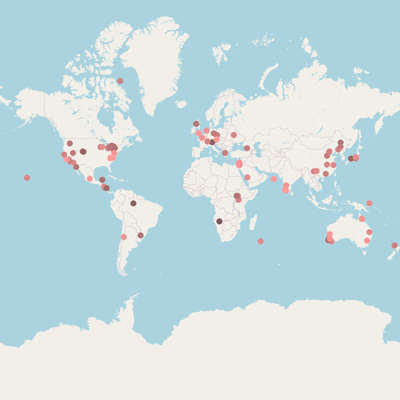
Global distribution of 16S sequence FJ612598 (>99% sequence identity) for Orbus hercynius subclade from Microbeatlas ![]()
| @ref | Description | Assembly level | INSDC accession | BV-BRC accession | IMG accession | NCBI tax ID | Score | |
|---|---|---|---|---|---|---|---|---|
| 66792 | ASM363427v1 assembly for Orbus hercynius DSM 22228 | scaffold | 593135 | 72.46 |
| @ref | Description | Accession | Length | Database | NCBI tax ID | |
|---|---|---|---|---|---|---|
| 16215 | Orbus hercynius strain CN3 16S ribosomal RNA gene, partial sequence | FJ612598 | 1522 | 593135 |
| @ref | Trait | Model | Prediction | Confidence in % | In training data |
|---|---|---|---|---|---|
| 125439 | spore_formation | BacteriaNetⓘ | no | 98.70 | no |
| 125439 | motility | BacteriaNetⓘ | yes | 60.90 | no |
| 125439 | gram_stain | BacteriaNetⓘ | negative | 98.20 | no |
| 125439 | oxygen_tolerance | BacteriaNetⓘ | obligate aerobe | 96.60 | no |
| @ref | Trait | Model | Prediction | Confidence in % | In training data |
|---|---|---|---|---|---|
| 125438 | gram-positive | gram-positiveⓘ | no | 99.00 | no |
| 125438 | anaerobic | anaerobicⓘ | no | 85.40 | yes |
| 125438 | aerobic | aerobicⓘ | no | 75.35 | no |
| 125438 | spore-forming | spore-formingⓘ | no | 89.71 | no |
| 125438 | thermophilic | thermophileⓘ | no | 96.58 | no |
| 125438 | flagellated | motile2+ⓘ | no | 90.33 | yes |
| Title | Authors | Journal | DOI | Year | |
|---|---|---|---|---|---|
| The Pathfinder plasmid toolkit for genetically engineering newly isolated bacteria enables the study of Drosophila-colonizing Orbaceae. | Elston KM, Phillips LE, Leonard SP, Young E, Holley JC, Ahsanullah T, McReynolds B, Moran NA, Barrick JE. | ISME Commun | 10.1038/s43705-023-00255-3 | 2023 | |
| Orbus hercynius gen. nov., sp. nov., isolated from faeces of wild boar, is most closely related to members of the orders 'Enterobacteriales' and Pasteurellales. | Volkmann M, Skiebe E, Kerrinnes T, Faber F, Lepka D, Pfeifer Y, Holland G, Bannert N, Wilharm G | Int J Syst Evol Microbiol | 10.1099/ijs.0.019026-0 | 2009 | |
| Cultivation and characterization of the gut symbionts of honey bees and bumble bees: description of Snodgrassella alvi gen. nov., sp. nov., a member of the family Neisseriaceae of the Betaproteobacteria, and Gilliamella apicola gen. nov., sp. nov., a member of Orbaceae fam. nov., Orbales ord. nov., a sister taxon to the order 'Enterobacteriales' of the Gammaproteobacteria. | Kwong WK, Moran NA | Int J Syst Evol Microbiol | 10.1099/ijs.0.044875-0 | 2012 | |
| Orbus sasakiae sp. nov., a bacterium isolated from the gut of the butterfly Sasakia charonda, and emended description of the genus Orbus. | Kim JY, Lee J, Shin NR, Yun JH, Whon TW, Kim MS, Jung MJ, Roh SW, Hyun DW, Bae JW | Int J Syst Evol Microbiol | 10.1099/ijs.0.041871-0 | 2012 |
| #16215 | Leibniz Institut DSMZ-Deutsche Sammlung von Mikroorganismen und Zellkulturen GmbH ; Curators of the DSMZ; DSM 22228 |
| #20215 | Parte, A.C., Sardà Carbasse, J., Meier-Kolthoff, J.P., Reimer, L.C. and Göker, M.: List of Prokaryotic names with Standing in Nomenclature (LPSN) moves to the DSMZ. IJSEM ( DOI 10.1099/ijsem.0.004332 ) |
| #29700 | Barberan A, Caceres Velazquez H, Jones S, Fierer N.: Hiding in Plain Sight: Mining Bacterial Species Records for Phenotypic Trait Information. mSphere 2: 2017 ( DOI 10.1128/mSphere.00237-17 , PubMed 28776041 ) - originally annotated from #26083 (see below) |
| #61393 | Culture Collection University of Gothenburg (CCUG) ; Curators of the CCUG; CCUG 57622 |
| #66792 | Julia Koblitz, Joaquim Sardà, Lorenz Christian Reimer, Boyke Bunk, Jörg Overmann: Automatically annotated for the DiASPora project (Digital Approaches for the Synthesis of Poorly Accessible Biodiversity Information) . |
| #66794 | Antje Chang, Lisa Jeske, Sandra Ulbrich, Julia Hofmann, Julia Koblitz, Ida Schomburg, Meina Neumann-Schaal, Dieter Jahn, Dietmar Schomburg: BRENDA, the ELIXIR core data resource in 2021: new developments and updates. Nucleic Acids Res. 49: D498 - D508 2020 ( DOI 10.1093/nar/gkaa1025 , PubMed 33211880 ) |
| #69479 | João F Matias Rodrigues, Janko Tackmann,Gregor Rot, Thomas SB Schmidt, Lukas Malfertheiner, Mihai Danaila,Marija Dmitrijeva, Daniela Gaio, Nicolas Näpflin and Christian von Mering. University of Zurich.: MicrobeAtlas 1.0 beta . |
| #125438 | Julia Koblitz, Lorenz Christian Reimer, Rüdiger Pukall, Jörg Overmann: Predicting bacterial phenotypic traits through improved machine learning using high-quality, curated datasets. 2024 ( DOI 10.1101/2024.08.12.607695 ) |
| #125439 | Philipp Münch, René Mreches, Martin Binder, Hüseyin Anil Gündüz, Xiao-Yin To, Alice McHardy: deepG: Deep Learning for Genome Sequence Data. R package version 0.3.1 . |
| #126262 | A. Lissin, I. Schober, J. F. Witte, H. Lüken, A. Podstawka, J. Koblitz, B. Bunk, P. Dawyndt, P. Vandamme, P. de Vos, J. Overmann, L. C. Reimer: StrainInfo—the central database for linked microbial strain identifiers. ( DOI 10.1093/database/baaf059 ) |
You found an error in BacDive? Please tell us about it!
Note that changes will be reviewed and judged. If your changes are legitimate, changes will occur within the next BacDive update. Only proposed changes supported by the according reference will be reviewed. The BacDive team reserves the right to reject proposed changes.
Successfully sent
If you want to cite this particular strain cite the following doi:
https://doi.org/10.13145/bacdive17917.20251217.10
When using BacDive for research please cite the following paper
BacDive in 2025: the core database for prokaryotic strain data